
Understanding Why Your Cat Sleeps on You, Follows You, or Chooses You as “Home Base”
Cats express emotional connection through selective contact and proximity. Learn why some cats sleep on their humans, why others keep distance, and what these preferences reveal about trust.

Why Cats Seek Physical Contact with Humans: The Science of Comfort, Safety, and Trust
Cats show affection and trust in highly individual ways. Some sleep pressed against your ribs, some curl behind your knees, and others sit nearby without touching you. These patterns are not random—they reveal how the cat perceives safety, warmth, and emotional proximity.
Understanding these choices deepens your relationship without forcing behaviors that don’t fit your cat’s temperament.
Contact Seeking vs Proximity Seeking
Cats bond through presence more than physical touch. Behaviorists divide bonding into two categories:
Contact seekers
-
Sleep on your chest or legs
-
Curl against your side
-
Press their body into your hands
Proximity seekers
-
Stay in the same room but at a comfortable distance
-
Watch you from a shelf or chair
-
Approach intermittently rather than continuously
Both are valid and healthy attachment styles.
Why Cats Sleep on Humans
Sleeping on a human provides:
-
Warmth (cats maintain higher resting temperatures)
-
Security (you act as a predictable, protective anchor)
-
Scent reinforcement (merging your scent with theirs)
-
Monitoring (many cats prefer to rest where they can sense your micro-movements)
Cats are most vulnerable during sleep, so choosing your body indicates deep trust.
Why Some Cats Prefer Not to Sleep on You
Avoidance of direct contact does not mean a weak bond. Possible reasons include:
-
Higher baseline vigilance
-
Preference for cooler sleeping surfaces
-
Past experiences with heavy-handed handling
-
Stronger independent temperament
-
Taking the role of “environmental watcher” in multi-cat groups
Some deeply bonded cats sleep nearby but keep distance to maintain awareness.
Cats Use Humans as Emotional Anchors
Many cats display “secure base” behaviors:
-
Relaxation when resting near you
-
Increased confidence exploring unfamiliar spaces
-
Reduced stress when returning to you after a scare
-
Preference for your voice and scent as grounding stimuli
Even aloof cats often show micro-signals—tail tip twitches, soft blinks, slow approaches—that reflect emotional connection.
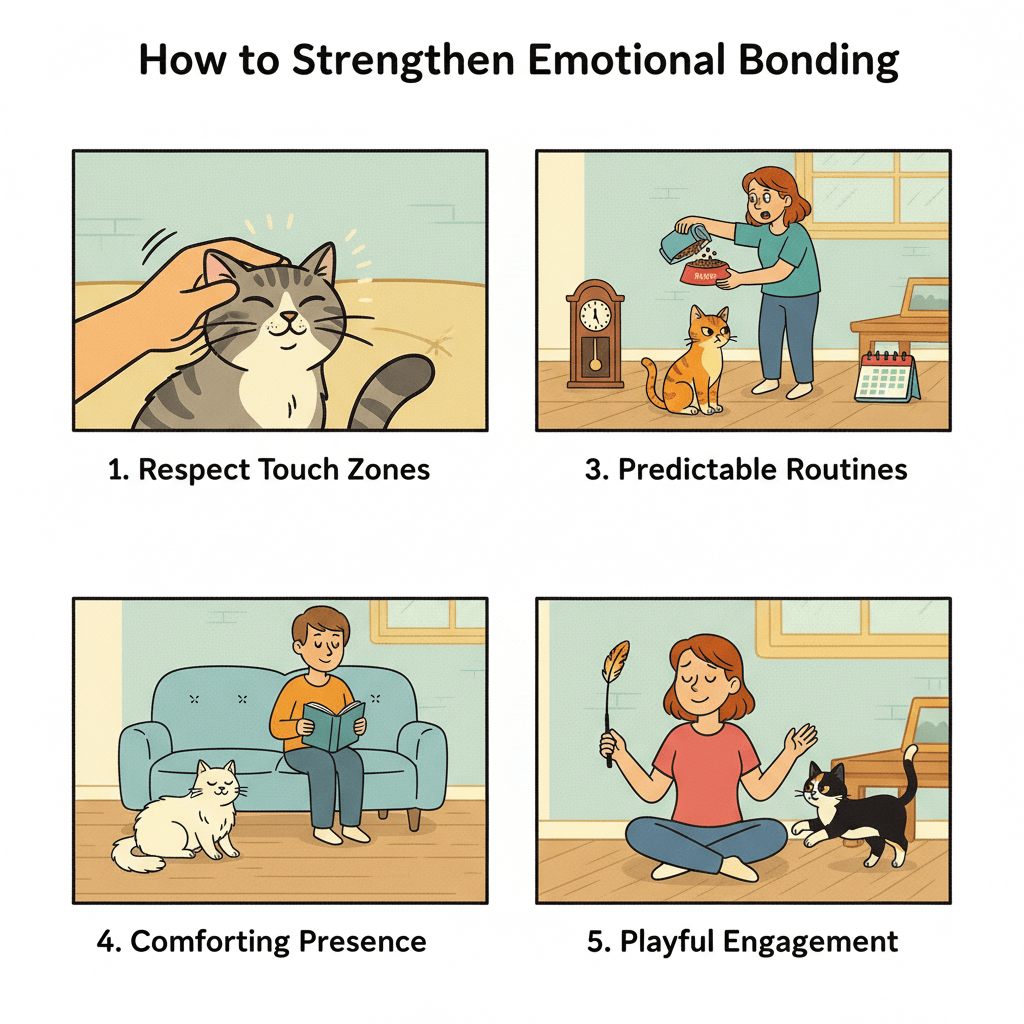
How to Strengthen Emotional Bonding
Respect preferred touch zones
Most cats prefer head, cheek, and neck scratches rather than full-body strokes.
Provide predictable routines
Emotional security is built on stability.
Offer comforting presence, not forced intimacy
Let the cat decide when and how much contact they want.
Maintain calm emotional energy
Cats read tension through micro-movements and breath patterns.
Use play as relational engagement
Hunting-style play communicates partnership and shared rhythm.
Summary
Cats express affection and emotional trust in diverse ways. Some show intense physical closeness, while others bond through quiet proximity. The core of human–cat bonding is not how much your cat touches you, but how safe they feel choosing to be near you.